Updated November 2026
A guide to seeing the aurora in Norway
The Northern Lights are seen most often in a broad ring around the far north of the planet, and the coast of northern Norway runs straight underneath it. From the Arctic Circle to the North Cape, a clear winter night and an active Sun can turn the whole sky green, sometimes for minutes, sometimes for hours.
The question we hear most is a simple one: when should I go, and how likely am I to see them? This guide answers it as honestly as we can, with the science in plain language, the best months, hours and places, flights from the UK, and the practical things that help on the night. If you already know you want to go, see all our Northern Lights voyages.
- SeasonLate September to late March
- Best hoursRoughly 6pm to 1am
- Best regionNorth of the Arctic Circle
- From the UKAbout 2 to 4 hours by air
- Guaranteed?Never, but the odds are good
The Science
What causes the Northern Lights?
The Northern Lights are caused by charged particles from the Sun colliding with gases high in Earth's atmosphere. The Sun sends out a constant stream of particles, the solar wind, and occasionally much larger bursts called coronal mass ejections. Earth's magnetic field deflects most of this, but some of the energy is stored in the magnetosphere and released down the field lines towards the poles. When the particles strike oxygen and nitrogen around 100 km or more above the ground, the gases glow.
Because the field lines converge near the magnetic poles, the energy is funnelled into two rings, the auroral ovals. In the north the result is the aurora borealis; in the south, the same process creates the aurora australis, or Southern Lights. A coronal mass ejection aimed at Earth can supercharge the whole system, and the US Space Weather Prediction Center notes that the fastest can reach Earth in as little as 15 to 18 hours. Norway's Arctic coast sits so close to the northern oval that the lights often appear directly overhead rather than as a glow on the horizon.
In the winter of 1882 to 1883 the Danish researcher Sophus Tromholt, observing from Kautokeino in Finnmark, put the average height of the aurora at 113 km. That is far above any weather, so cloud never affects the lights themselves, only your view of them.
Why are the Northern Lights green, red or purple?
- Green is the most common colour, from oxygen at roughly 100 to 300 km, most of it in the lower part of that band. Our eyes are also most sensitive to green.
- Red also comes from oxygen, but higher, at roughly 300 to 400 km. It shows at the top of tall curtains or during strong storms.
- Blue and purple come mainly from nitrogen. When particles reach below about 100 km, nitrogen gives the lower edge of a curtain a pink or purplish fringe.
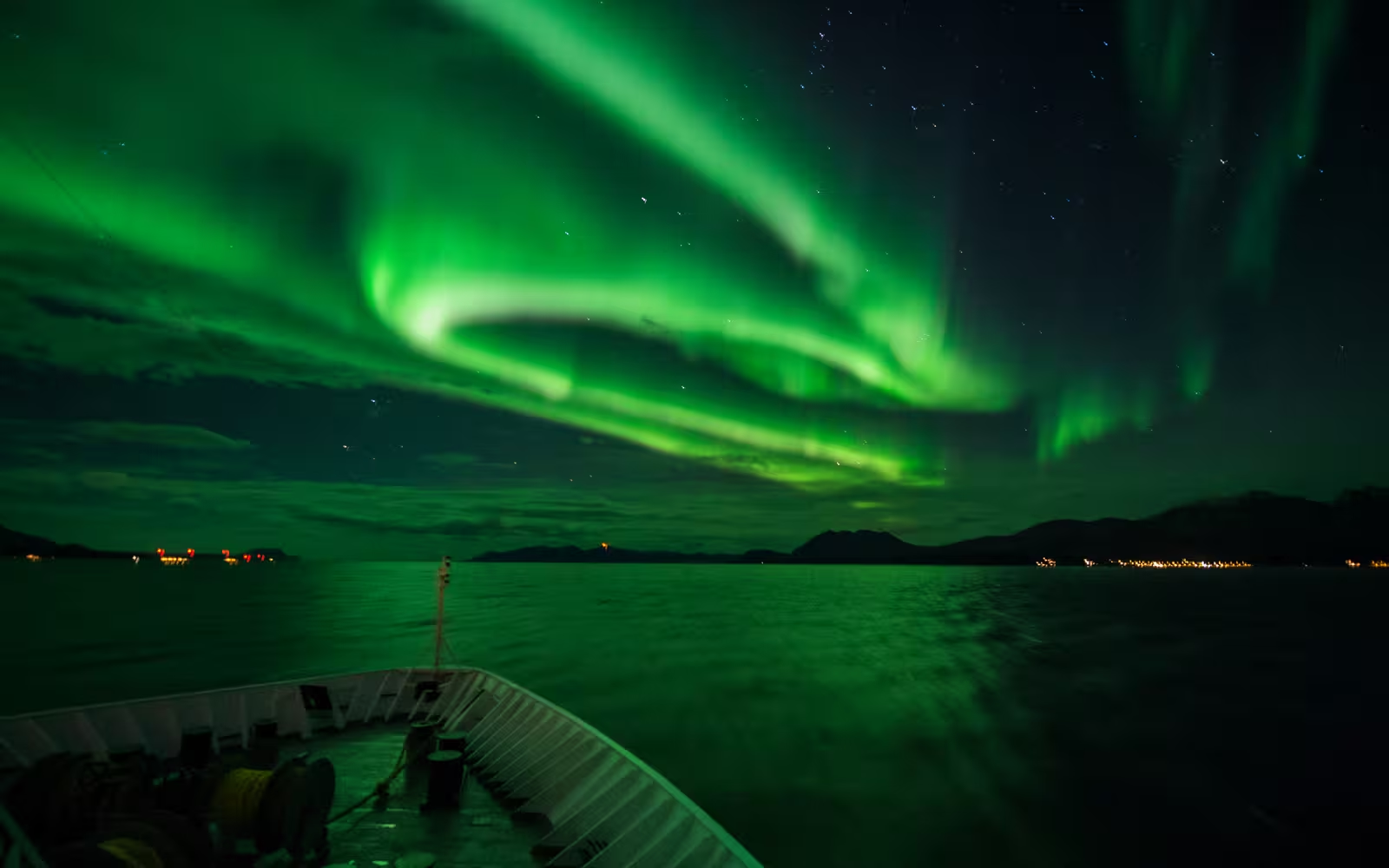
Cameras pick up colour in the dark far better than the eye, so a silvery arc on deck can come out bright green on your phone. The colour is real; our eyes simply struggle to see it in low light.
What is the Kp index?
The Kp index, quoted in every aurora app, is a scale from 0 to 9 measuring how disturbed Earth's magnetic field is. The higher the number, the further the oval spreads towards lower latitudes, and Kp 9 is the kind of extreme storm that brings the lights over southern England. Northern Norway needs nothing like that. With the oval more or less overhead, displays happen even at low Kp, so a modest forecast is no reason to stay indoors on a clear night.
Names and Folklore
Where does the name aurora borealis come from?
Aurora borealis joins Aurora, the Roman goddess of the dawn, with Boreas, the Greek name for the north wind. The term is often credited to Galileo Galilei in about 1619, though Pierre Gassendi was also using it by 1621. In Norwegian the lights are simply nordlys, the northern light.
One of the earliest written accounts from Norway is the King's Mirror, or Konungs skuggsjá, an Old Norse text from around the middle of the thirteenth century. It describes the lights seen from Greenland and weighs up three explanations: fire circling the outer ocean, sunlight escaping round the edge of the world, and frost and glaciers giving out light. The author found the last quite plausible, though he admitted he could not be sure.
For the Sámi, the indigenous people of the far north, the lights called for caution and respect. Many traditions linked them to the souls of the dead, and it was thought unwise to wave, whistle or sing beneath them in case they came down for you. Popular retellings of Norse belief, meanwhile, connect the lights with the shining armour of the Valkyries, or with Bifröst, the bridge between earth and heaven. These are better enjoyed as folklore and later interpretation than read as firm history.
Alta
Where aurora science began
Finnmark · About 70 degrees north
Alta calls itself the city of the Northern Lights, with good reason. The world's first permanent Northern Lights observatory was built on the mountain of Haldde above the town and came into use in 1899 on the initiative of the physicist Kristian Birkeland, with parliament funding its running. The oldest surviving published aurora photograph was taken here too, by Martin Brendel in 1892.
The research moved to Tromsø, where a new observatory opened in 1928, but the spiralling Northern Lights Cathedral in the middle of Alta keeps the connection alive, and the area is known for some of the clearest winter skies in Norway.
Timing
When is the best time to see the Northern Lights in Norway?
The best time to see the Northern Lights in Norway is between late September and late March, on a clear, dark night, usually between about 6pm and 1am. The aurora happens all year, but from April to August the far north is too light to see it, and in high summer the Midnight Sun means there is no darkness at all. On any given night, what matters is solar activity, darkness and cloud.
Which month is best?
There is no single best month, and anyone who promises one is guessing. Each part of the season has its own character on the coast north of the Arctic Circle.
| Month | What it is like on the coast | Darkness |
|---|
| Late September and October | Autumn colour, milder air and nights lengthening fast, with the September equinox often an active time. | Good |
| November | Snow arriving and long evenings. The polar night begins in Tromsø towards the end of the month. | Very good |
| December and early January | The heart of the polar night, with a blue twilight at midday and darkness most of the day. | Longest |
| Late January and February | The light returns and the scenery is at its most wintry. | Very good |
| March | Brighter days for sightseeing, still properly dark nights, and the spring equinox. | Good |
A general guide only. Weather and solar activity vary from night to night, and the aurora can never be guaranteed in any month.
What time of night are the Northern Lights most active?
Displays can begin as soon as it is properly dark, which in midwinter can be mid afternoon. The most likely hours are roughly 6pm to 1am, and the US Space Weather Prediction Center says the best aurora is usually within an hour or two of midnight. Plenty of strong displays arrive earlier, though, so keep an eye on the sky from dinner onwards. Activity comes in waves, with a quiet arc suddenly brightening into moving curtains before calming again.
The polar night
Above the Arctic Circle there is a period around midwinter when the sun does not rise at all. In Tromsø it lasts from about 27 November to 15 January. It is not pitch black for weeks, as people imagine: around midday there are a few hours of deep blue and pink twilight, and the long darkness either side gives the aurora many more hours in which to appear.
Are the equinoxes really better?
There is good science behind the idea that the months around the equinoxes tend to be more geomagnetically active. Known as the Russell McPherron effect, it comes from the way Earth's magnetic field lines up with the field carried by the solar wind at that time of year, letting more energy in. Going by British Geological Survey data, a sizeable magnetic storm happens, on average, on nearly twice as many days in March as in June or July. It is a tendency, not a rule.
The solar cycle
The Sun runs through a cycle of roughly eleven years. In October 2024 NASA and NOAA announced that it had reached the solar maximum period of Solar Cycle 25. Maximum is a phase rather than a single date, and strong storms can still come in the years of decline that follow. Nobody can forecast individual displays this far ahead, but even in quiet years northern Norway sits close enough to the oval for the lights to be a regular sight.
The Moon and the weather
A full moon will not hide a good display but does wash out fainter ones, so the weeks around the new moon have the edge. Cloud matters more, and the coast has changeable weather, which is one of the best arguments for travelling by ship.
Where to Look
Where is the best place to see the Northern Lights in Norway?
The best places to see the Northern Lights in Norway are north of the Arctic Circle, from Lofoten and Vesterålen through Tromsø and Alta to the North Cape and Kirkenes. All lie under or close to the auroral oval. Further south, in Bergen, Oslo or the fjords, the lights are only seen during stronger storms. The Hurtigruten route crosses the Arctic Circle at about 66 degrees 33 minutes north and then spends several days in this region.
Tromsø
The capital of the Arctic
About 69 degrees 39 minutes north
Tromsø is the largest town in northern Norway and probably Europe's best known aurora destination. It sits right under the auroral oval, has a long tradition of aurora research, and is home to the world's northernmost planetarium and the striking Arctic Cathedral.
Coastal Express ships call in both directions. The northbound call is the longer one, with time to explore, and the optional winter excursions here include an evening husky ride out of town, away from the street lights, with a chance of the aurora overhead.
Lofoten, Vesterålen and Senja
About 68 to 69 degrees north
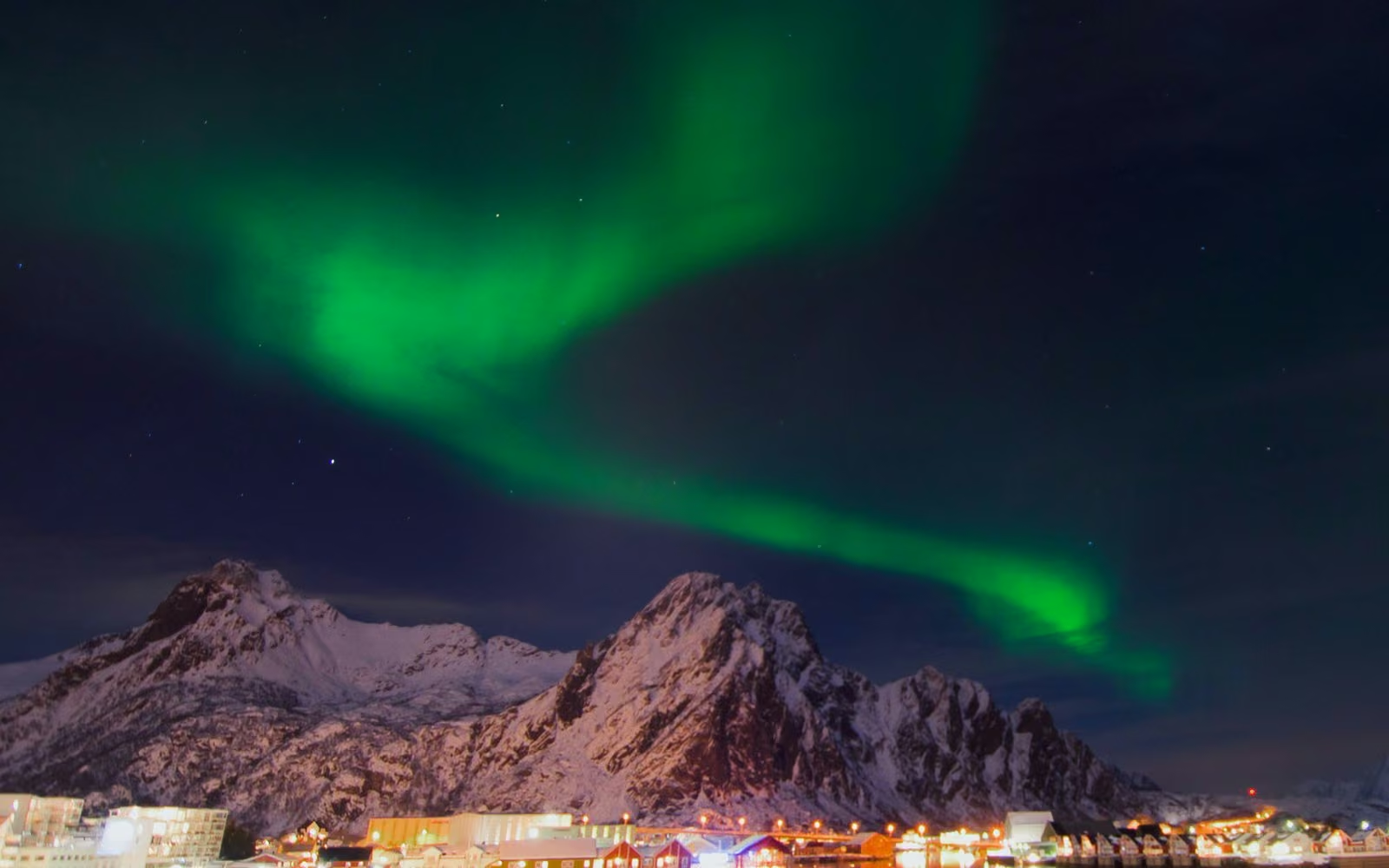
The peaks of Lofoten rising straight out of the sea make one of the finest backdrops for the aurora anywhere. The ship calls at Stamsund and Svolvær, then threads the narrow Raftsundet towards Vesterålen, where Stokmarknes is home to the Hurtigruten Museum. Further north, Finnsnes is the gateway to Senja, an island of mountains and fishing villages with very little artificial light.
Alta
About 70 degrees north
Sheltered by mountains at the head of its fjord, Alta has a reputation for clear skies. The Coastal Express does not call here, but the North Cape Line and Arctic Line voyages do, some with an evening or overnight stay so you can head out under dark skies.
The North Cape
The top of Europe
71 degrees 10 minutes 21 seconds north
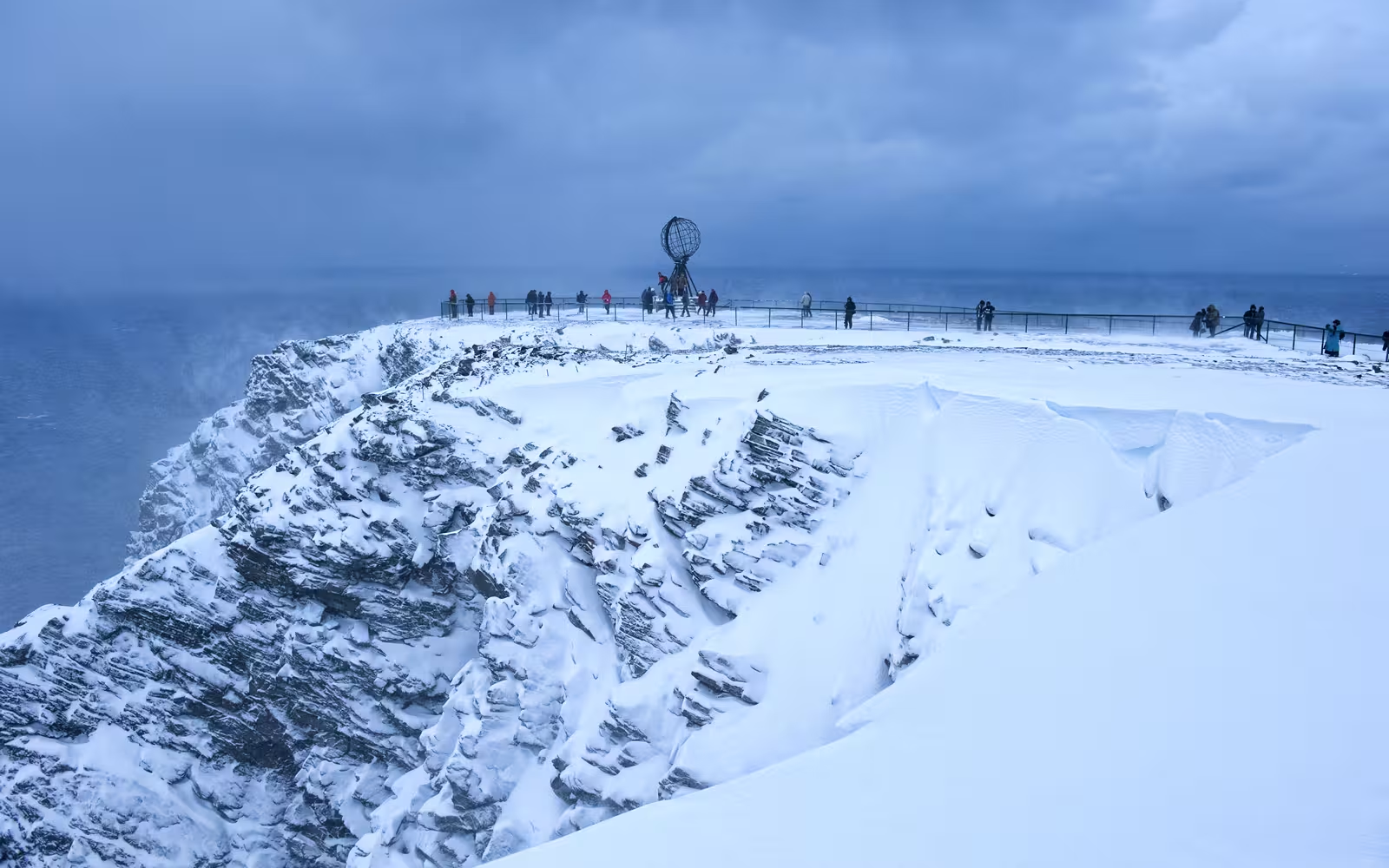
The famous headland on the island of Magerøya rises 307 metres out of the Arctic Ocean. Ships call at nearby Honningsvåg, and excursions travel up to the plateau, in winter often in a convoy behind a snowplough.
There is almost no light pollution here and the horizon is open in every direction. On a clear night with activity, it is about as good as aurora watching gets.
Kirkenes
About 69 degrees 43 minutes north
At the end of the Coastal Express route, close to the borders with Finland and Russia, Kirkenes has a colder, often crisper winter than the outer coast. It is the base for snowmobile and husky trips, king crab safaris and nights at the Snowhotel.
Svalbard
About 78 degrees north
Svalbard is so far north that in midwinter it sits beneath the dayside part of the oval, and researchers there can watch a red dayside aurora in the late morning. Our Svalbard voyages sail in the summer months of the Midnight Sun, though, so for the Northern Lights the mainland coast in winter is the place.
Can you see the Northern Lights in Bergen or Oslo?
About 60 degrees north
Occasionally, during strong storms. The great storm of May 2024 carried the lights well into southern England, never mind Bergen. On a normal winter night, though, think of Bergen as where your voyage begins, and the Arctic as where you start looking up.
Hurtigruten Northern Lights
Why is a Hurtigruten voyage a good way to see the Northern Lights?
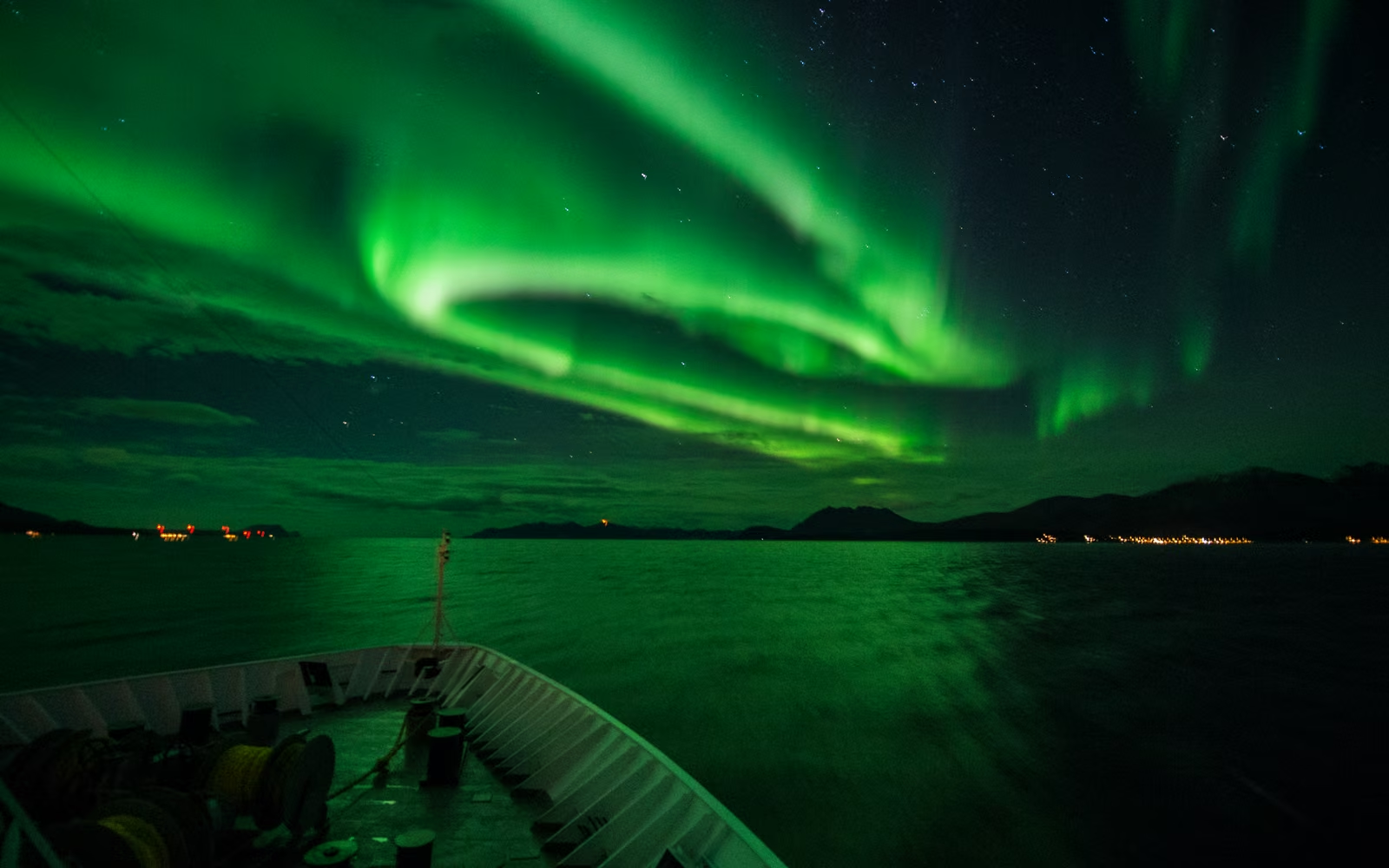
A voyage puts you in the auroral zone for several nights in a row, far from town lights, on a ship that keeps moving and can carry you away from local cloud. Crew announce sightings day and night, so you are not standing in the cold waiting, and you never have to drive icy roads in the dark.
- Several nights in the zone. A 12 day Coastal Express round voyage spends around six nights north of the Arctic Circle. A short city break gives you two or three, and one cloudy spell can wipe them out.
- Dark skies at sea. Away from port, the only lights are the ship's own and the odd farm on the shore.
- A moving viewpoint. Coastal cloud is often local, and a clear patch further up the coast is common.
- Someone else is watching. Hurtigruten says crew announce sightings to cabins at any time of day or night, and cabins and suites have a Northern Lights alert that you can switch on or off.
- Warmth on hand. When your fingers go numb, a hot drink and the panoramic lounge are a few steps away.
- Expertise. On the North Cape Line and Arctic Line the Expedition Team give lectures and guidance on deck, and the Astronomy departures carry a specialist astronomer.
On Deck
Watching from the ship
The open decks and the panoramic lounge
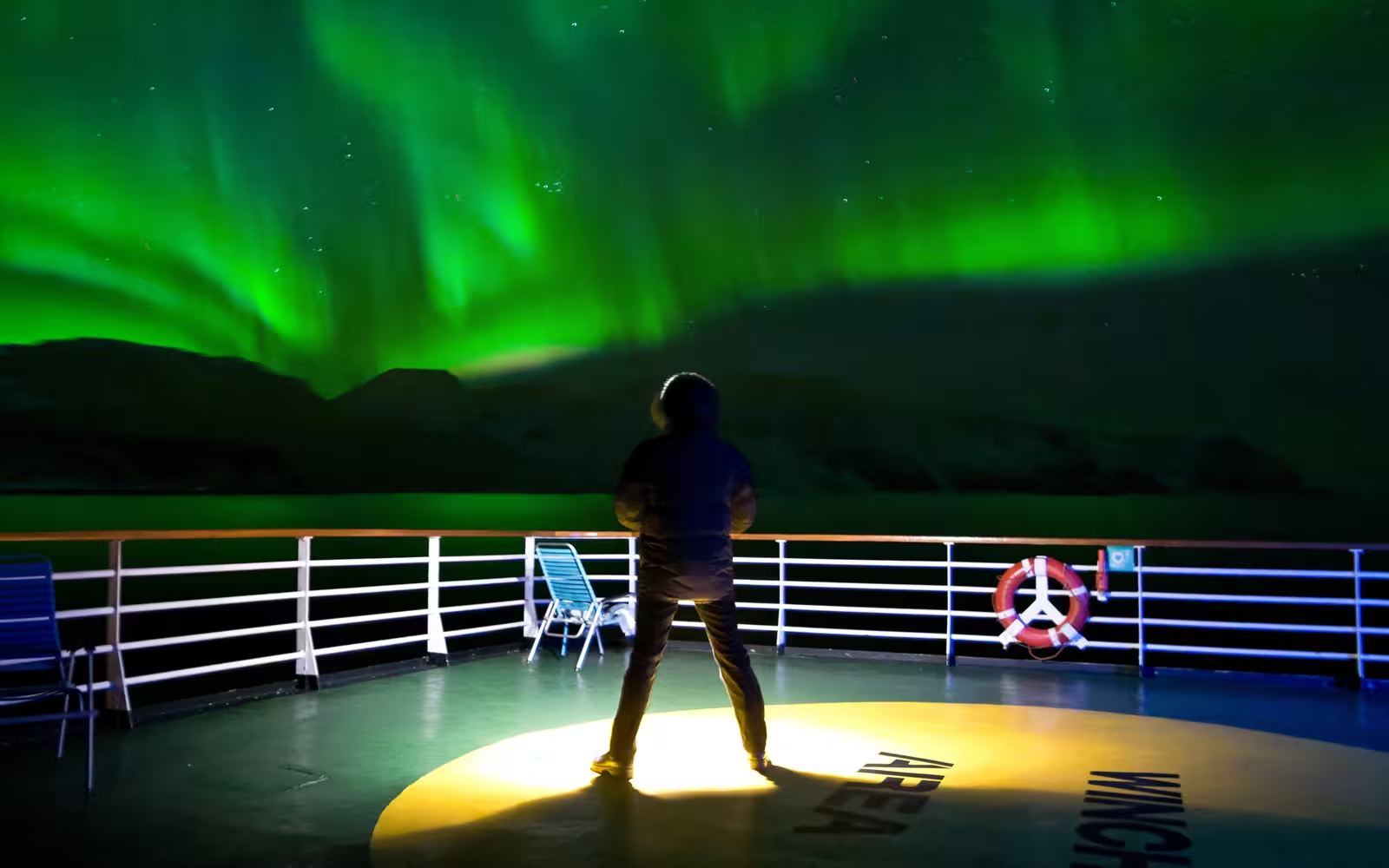
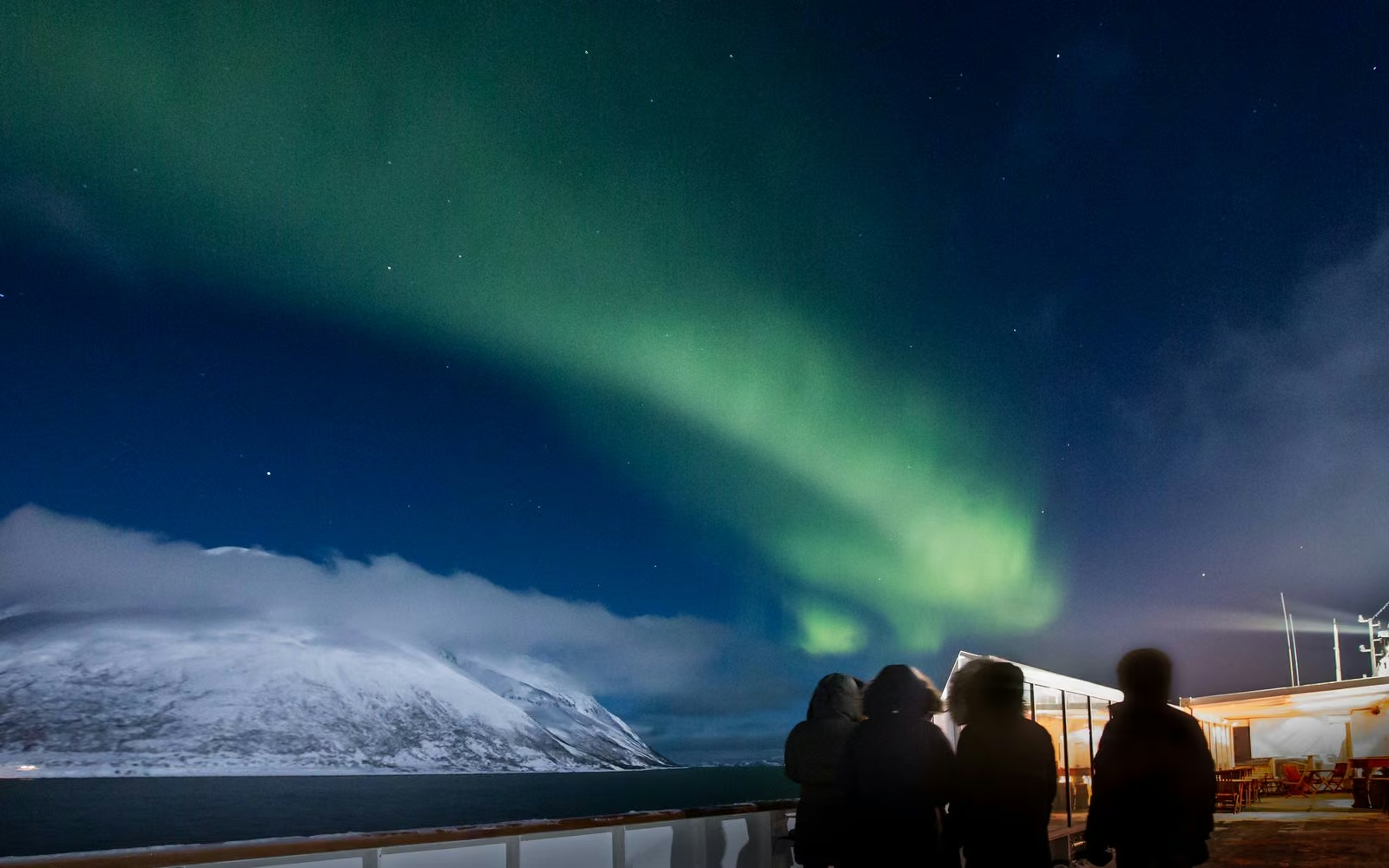
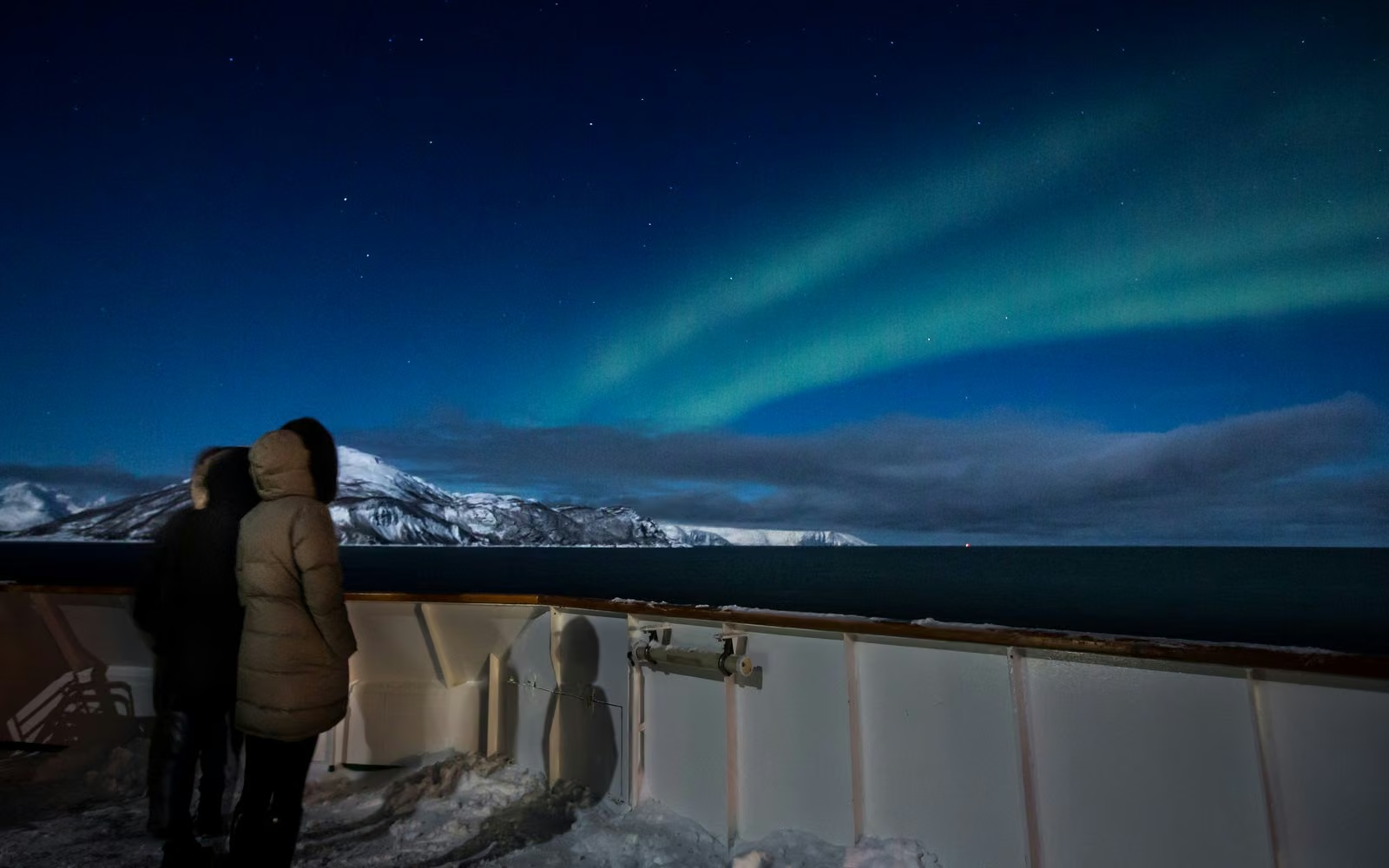
When the call comes, most people grab a coat and head for the open deck. The best views are usually from the darkest side, away from the deck lights, and it is worth giving your eyes a few minutes before judging how strong the display is.
The reward is a foreground of mountains, islands and lit villages sliding past under the lights, which no fixed viewpoint can match. Read more about life on board a Hurtigruten ship.
Sail With Confidence
What is the Hurtigruten Northern Lights Promise?
The Northern Lights Promise covers qualifying Hurtigruten voyages of 11 days or more departing between 20 September and 31 March. If the aurora is not officially sighted during your voyage, meaning recorded by the ship's deck officers and announced to passengers, Hurtigruten gives you a free 6 or 7 day Coastal Express voyage the following season, depending on when you sail.
It applies to the 12 day Coastal Express round voyage, including the charter flight and Astronomy departures, the 15 day North Cape Line and the Arctic Line on qualifying dates. It does not cover shorter voyages such as the 8 day Arctic Circle Explorer, and the free voyage does not include flights. Full conditions are on our special offers page. It is not a guarantee that you will see the lights, which nobody can offer, but it shows how confident Hurtigruten is about eleven or more winter nights on this coast.
Hurtigruten Film
Winter on the Norwegian coast
A short film from Hurtigruten capturing the coast in the dark months: snow on the mountains, the blue polar twilight and the ships that sail through it.
Video from Hurtigruten's official YouTube channel.
Choose Your Voyage
Our Northern Lights voyages
All of these sail through the auroral zone in the dark months. Open any voyage for dates and current fares, or see all our Northern Lights voyages side by side.
Coastal Express voyages
Signature voyages
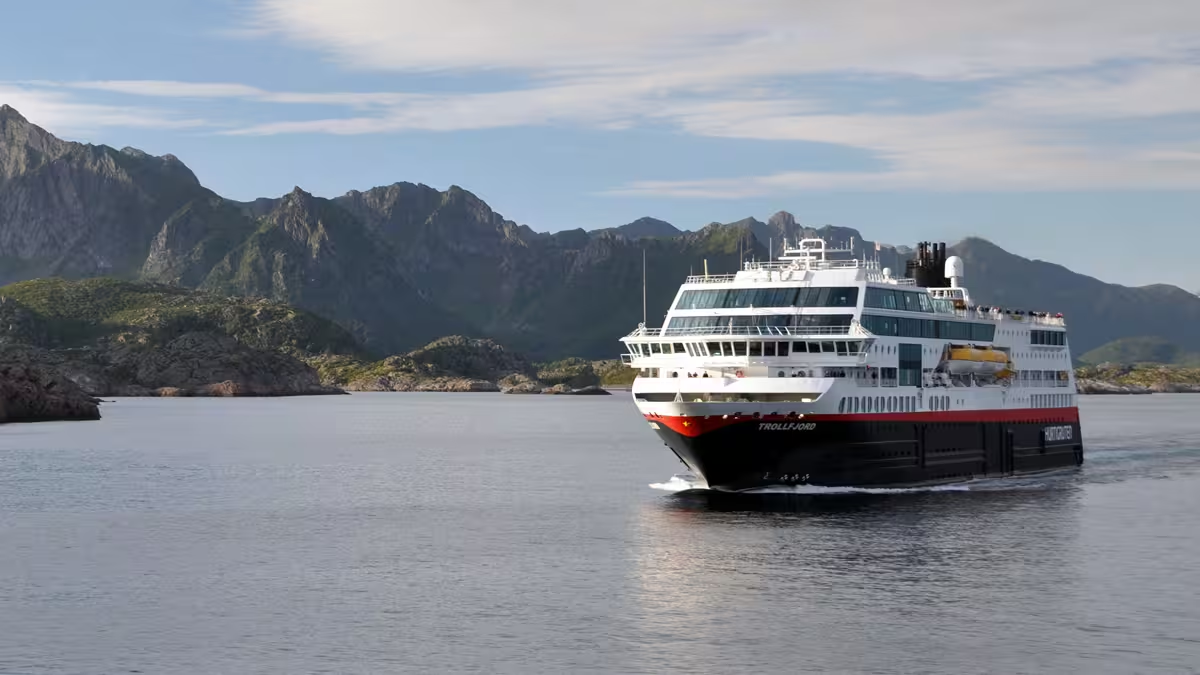
Oslo · Honningsvåg · Oslo · 15 Days · All Inclusive
North Cape Line Round Voyage
Oslo to the North Cape and back on MS Trollfjord, via Lofoten, Tromsø and Alta. Winter departures carry the Promise.
View Voyage ›
Oslo · Honningsvåg · Oslo · 15 Days · All Inclusive
North Cape Line Astronomy Cruise
Two March 2027 departures with an expert astronomer on board throughout, plus masterclasses and exclusive excursions.
View Voyage ›
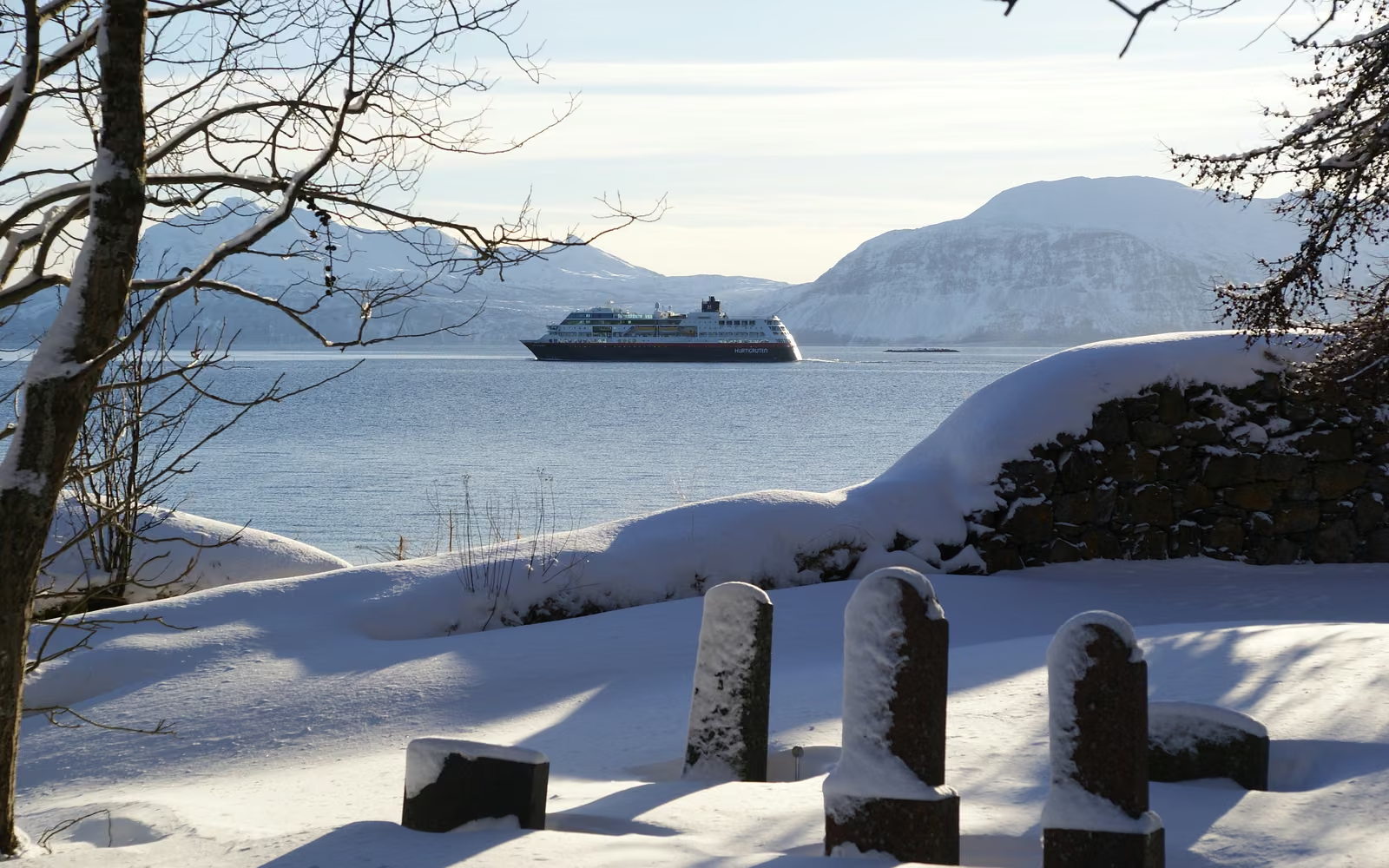
Oslo · Tromsø · 7 Days · All Inclusive
North Cape Line North
The northbound half of the North Cape Line, a week from Oslo to Tromsø with the final nights above the Arctic Circle.
View Voyage ›

Tromsø · Honningsvåg · Oslo · 9 Days · All Inclusive
North Cape Line South
Begin in Tromsø with the North Cape and Alta, the best aurora country on the route, then sail south to Oslo.
View Voyage ›
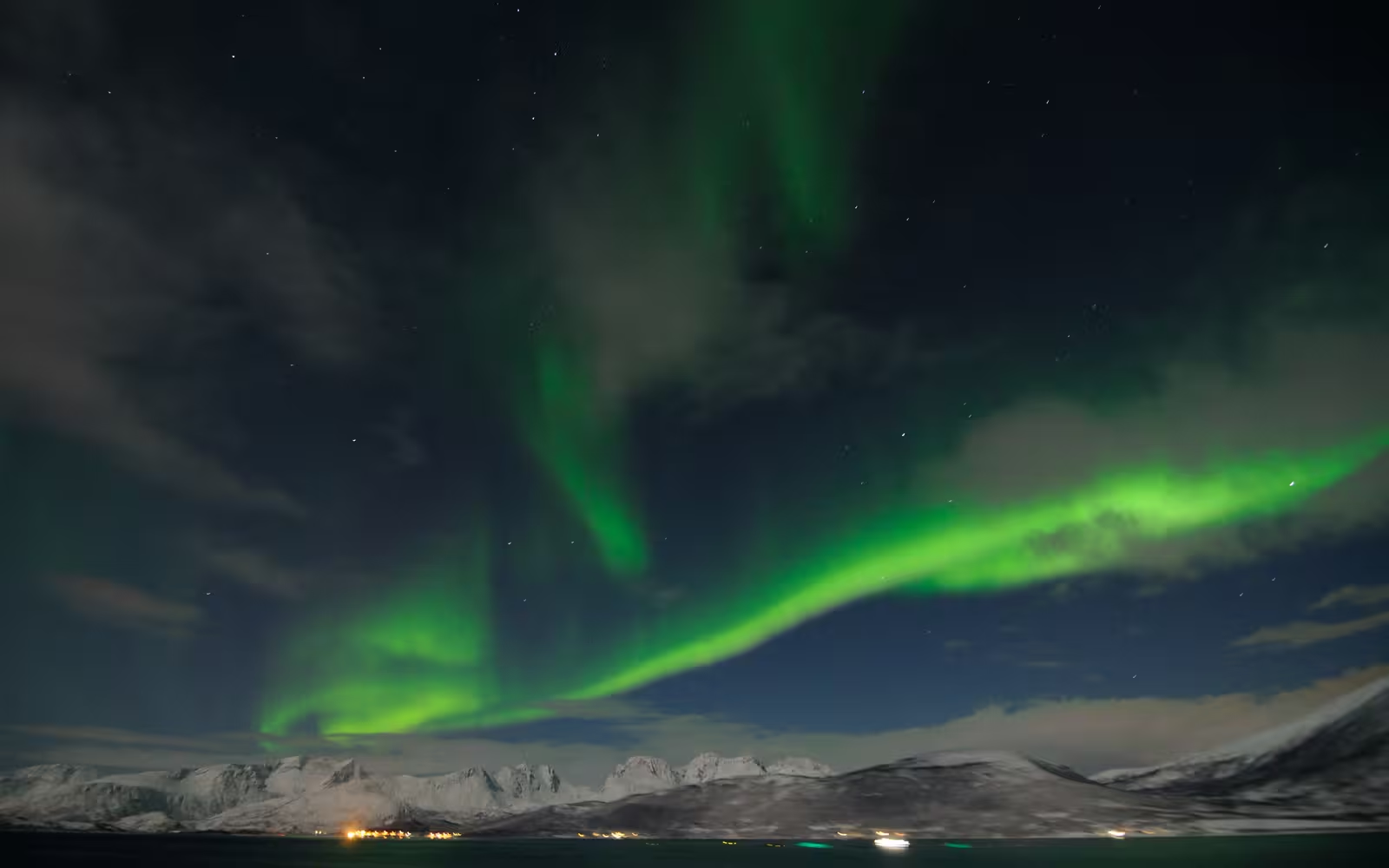
Copenhagen · Tromsø · 12 Days · All Inclusive
Arctic Line North
A winter route on MS Trollfjord from Copenhagen to Tromsø, with Lofoten, an overnight in Alta and the North Cape.
View Voyage ›
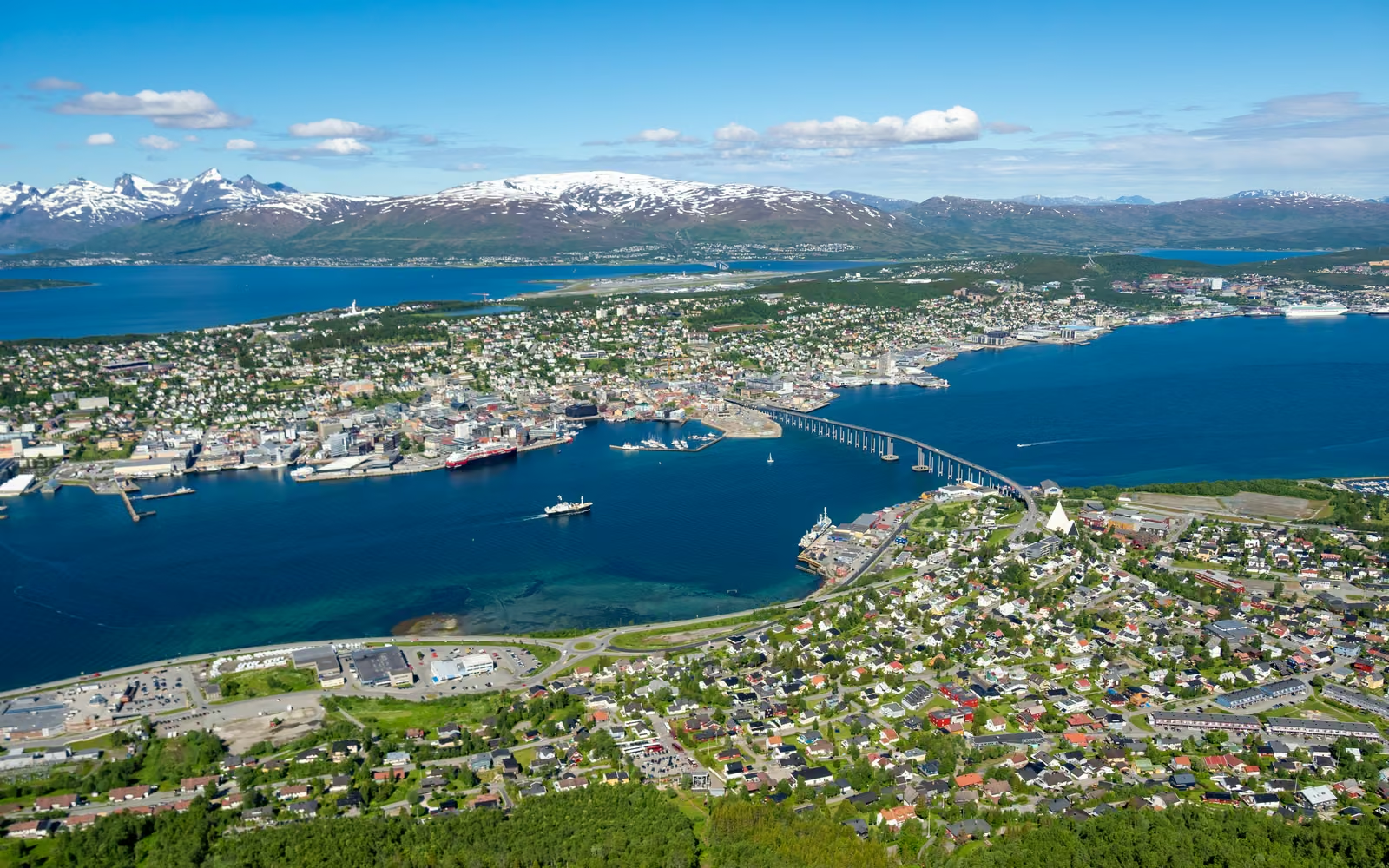
Tromsø · Copenhagen · 11 Days · All Inclusive
Arctic Line South
The North Cape and Alta come first, in the darkest part of the trip, before Lofoten, the fjords and Copenhagen.
View Voyage ›

Tromsø · Honningsvåg · Tromsø · 8 Days · All Inclusive
Arctic Circle Explorer
Eight winter days that never leave the Arctic: Narvik, Lofoten, Alta and the North Cape. The Promise does not apply.
View Voyage ›
Cruise and tour
Oslo · Kirkenes · Helsinki · 16 Days
Follow the Northern Lights, Oslo to Helsinki
The Flåm Railway, the Coastal Express to Kirkenes, then Lapland with huskies and a glass igloo before Helsinki.
View Voyage ›
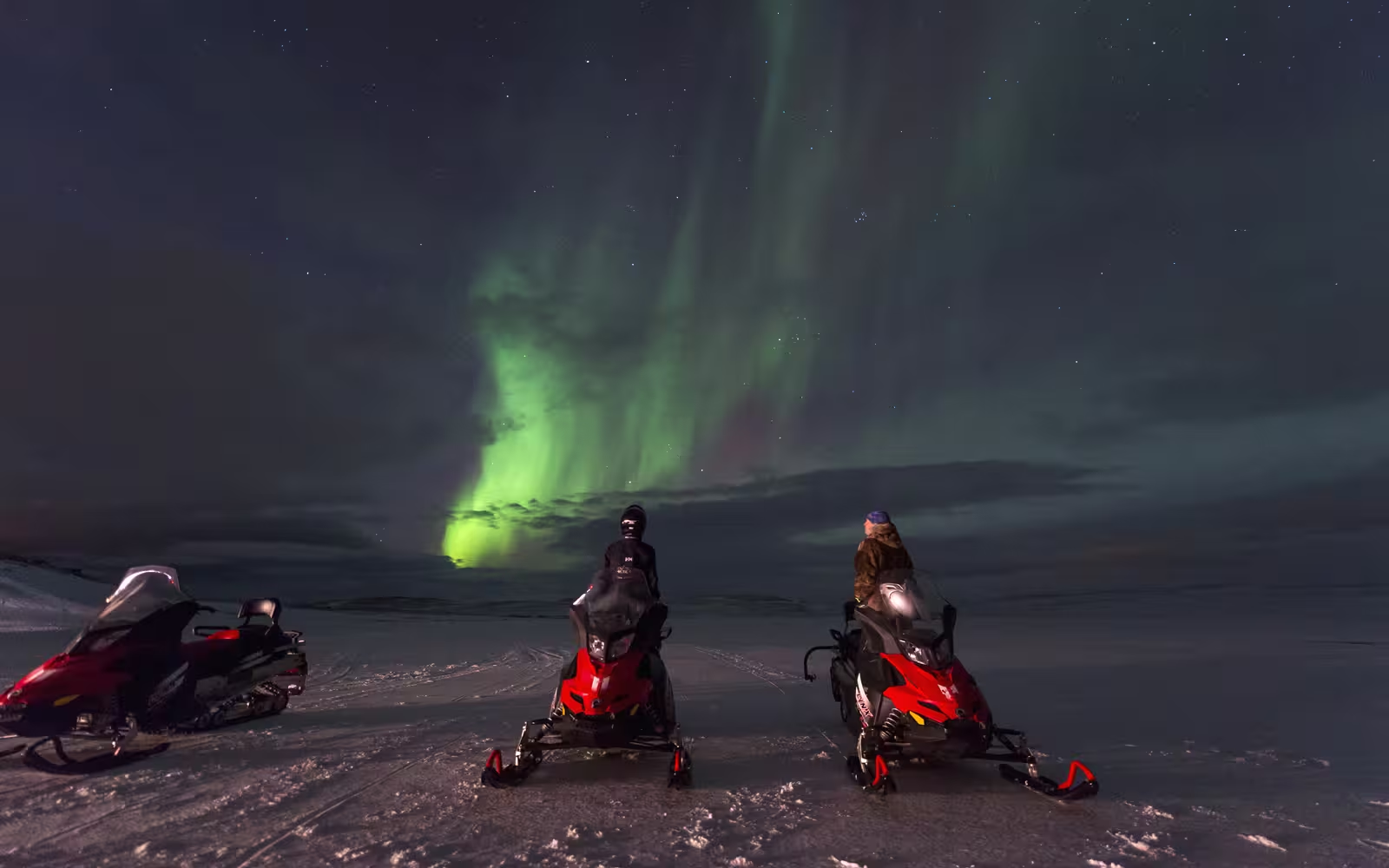
Helsinki · Kirkenes · Bergen · Oslo · 14 Days
Follow the Northern Lights, Helsinki to Oslo
Escorted through Lapland to Kirkenes with husky and reindeer safaris, then the Coastal Express south and the train to Oslo.
View Voyage ›
Oslo · Tromsø · Helsinki · 14 Days
Savour the Northern Lights, Oslo to Helsinki
Six all-inclusive nights on MS Trollfjord to Tromsø, then a guided week in Finnish Lapland ending in Helsinki.
View Voyage ›

Helsinki · Tromsø · Oslo · 16 Days
Savour the Northern Lights, Helsinki to Oslo
A guided week in Lapland with glass villas and huskies, then eight all-inclusive nights on MS Trollfjord to Oslo.
View Voyage ›
Copenhagen · Tromsø · Helsinki · 19 Days
Savour the Northern Lights, Copenhagen to Helsinki
Eleven all-inclusive nights on MS Trollfjord to Tromsø, then an icebreaker, huskies and a glass igloo in Lapland.
View Voyage ›
Helsinki · Tromsø · Copenhagen · 18 Days
Savour the Northern Lights, Helsinki to Copenhagen
Through Lapland by train and coach to Tromsø, then MS Trollfjord north to the North Cape and south to Copenhagen.
View Voyage ›
Getting There
Can you see the Northern Lights from the UK?
Occasionally, during strong geomagnetic storms, with the far north of Scotland the most likely place. Northern Norway sees the lights far more often, and you can fly there from the UK in just a few hours: around two hours from London to Bergen or Oslo, and around three and a half to four hours from London or Manchester to Tromsø.
Most of the time the UK lies well south of the auroral oval. On 10 and 11 May 2024, though, a storm at the top of the Kp scale, one of the most extreme the British Geological Survey has recorded in 155 years, brought the aurora across much of the country, including southern England. Nights like that are rare. For a realistic chance of seeing the lights overhead, you need to go north.
Northern Lights holidays from the UK
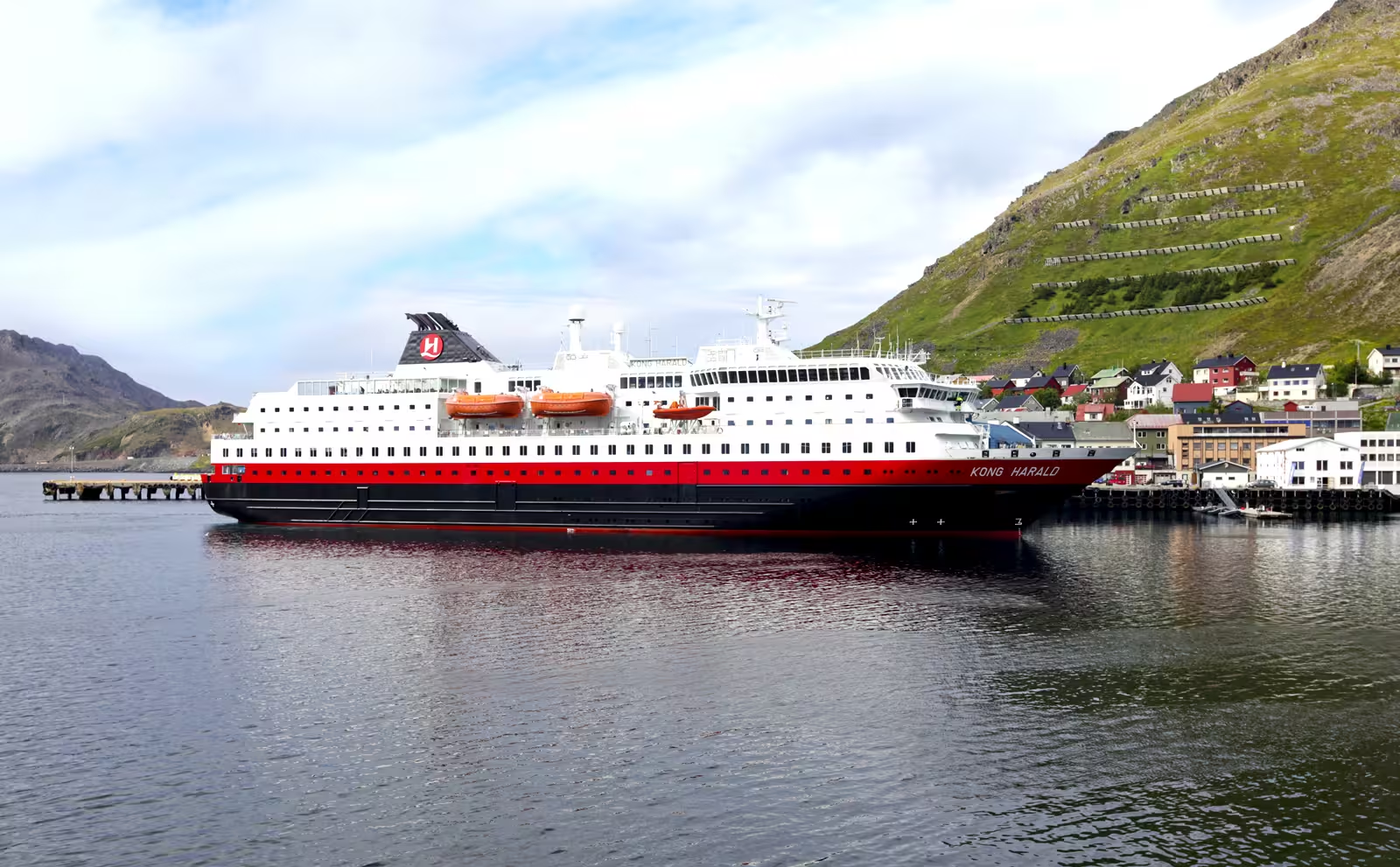
- Charter flights direct to Bergen. Selected winter Coastal Express round voyages on MS Kong Harald include a direct charter flight from Manchester, London Stansted or Newcastle, with transfers. See the Coastal Express with charter flights.
- Hurtigruten flight packages. Hurtigruten offers flight-inclusive packages on many voyages, using scheduled flights from London Gatwick, London Heathrow and Manchester, which may be indirect. Hurtigruten states that these packages come with ABTA and ATOL protection.
- Arranged by us. We can quote your voyage with flights, add hotel nights in Bergen, Oslo or Kirkenes, and put the whole trip together. Call 0333 405 0194.
- Your own flights. At the time of writing, Norwegian flies direct from London Gatwick to Bergen and to Oslo, and easyJet and Norwegian fly direct to Tromsø from London Gatwick and Manchester. Norwegian is also adding a twice weekly winter route from Glasgow to Tromsø, from 11 December 2026 to 22 March 2027. Schedules change each season, so check before you book.
As the Coastal Express calls at towns with airports all along the coast, you can also fly into Tromsø or Kirkenes and join a one way voyage. Our how to book page explains the options.
On The Night
How to see the Northern Lights: practical tips
Find somewhere dark with a clear view north, dress far more warmly than you think you need, give your eyes time to adjust and be patient. The lights often build slowly and then flare suddenly, so the people who see the best displays are usually the ones who stay out a little longer.
- Look north, then up. Displays often start as a pale arc low in the northern sky and then spread overhead, so keep turning round.
- Let your eyes adjust. It takes 20 minutes or more to adapt fully to the dark, so keep your phone screen dimmed.
- Do not dismiss a grey glow. A faint whitish band can be the start of a display. If a quick phone photo shows green, keep watching.
- Use forecasts, but do not rely on them. Aurora apps cannot see the cloud over your head. On the ship, the crew alert is the best forecast of all.
How to photograph the Northern Lights
- Keep it steady. Use a small tripod or brace the camera on a rail. On a ship, shorter exposures work better because the deck moves slightly.
- Go wide. A wide angle lens with the aperture fully open takes in more sky and the scenery below.
- Focus on infinity. Switch to manual focus and set it on a bright star or distant light.
- Exposure and ISO. Start with a few seconds, perhaps 2 to 8, at ISO 800 to 3200, and shorten the exposure when the lights are bright and moving fast.
- Flash off, and keep spare batteries warm in an inside pocket, as the cold drains them quickly.
- Phones. Most recent smartphones have a night mode that does a surprisingly good job if you hold them still.
Most of all, put the camera down for a while and simply watch. Photographs never quite capture the movement of a big display.
Weather and Packing
What is the weather like on the Norwegian coast in winter?
The Norwegian coast is much milder in winter than its latitude suggests, because the North Atlantic Current and its extension, the Norwegian Current, carry warmer water up the coast. Tromsø averages a few degrees below freezing in midwinter and Bergen a few degrees above, while inland areas at the same latitude are far colder.
Milder is not warm, though. A still night on an open deck with a sea breeze feels much colder than the thermometer says, and clear nights, the ones you want, are the coldest. Our climate and seasons guide has month by month detail.
What to pack for a Northern Lights trip
- Layers: a thermal base, a fleece or wool mid layer and a windproof, waterproof jacket.
- Hat, scarf and gloves, with thin liner gloves under mittens so you can work a camera.
- Warm, waterproof boots with a good grip, wool socks, and slip on ice grips for walks ashore.
- A head torch with a red light, which helps you see without spoiling your night vision.
Inside, the ship is warm and dress is relaxed. For snowmobile or husky excursions, warm outer clothing is often provided, but check the details when you book.
Questions
Northern Lights in Norway: frequently asked questions
Can you guarantee I will see the Northern Lights?
No. Nobody can, because the aurora depends on the Sun and on clear skies. You give yourself the best chance by travelling in the dark season, spending several nights north of the Arctic Circle and getting away from artificial light, which a winter voyage does on every count.
What is the best month to see the Northern Lights in Norway?
Any month from late September to late March can be good. December and early January have the most darkness, while October and March offer milder weather, more daylight for sightseeing and a tendency to more geomagnetic activity around the equinoxes.
What time of night are the Northern Lights best?
The most likely hours are roughly 6pm to 1am, and displays are often strongest within an hour or two of midnight. Strong displays can start early in the evening, so watch the sky from dusk.
Can you see the Northern Lights in summer in Norway?
No. From about April to August the sky in northern Norway is too light, and around midsummer the Midnight Sun means it never gets dark. The viewing season runs from late September to late March.
Can you see the Northern Lights from Bergen?
Only occasionally, during strong storms, as Bergen lies around 60 degrees north. Your chances improve greatly once the ship crosses the Arctic Circle, on the fourth day of a northbound Coastal Express voyage.
Do I need a tour, or can I see the lights from the ship?
You can see them perfectly well from the ship. Crew announce sightings and cabins have a Northern Lights alert, so you are unlikely to miss a display. Optional excursions ashore simply add a different setting.
What is the Northern Lights Promise?
On qualifying Hurtigruten voyages of 11 days or more departing between 20 September and 31 March, if the Northern Lights are not officially sighted during your voyage, Hurtigruten gives you a free 6 or 7 day Coastal Express voyage the following season, depending on when you sail. Flights are not included.
How long is the flight from the UK to see the Northern Lights?
A direct flight from London to Bergen or Oslo takes around two hours, and from London Gatwick or Manchester to Tromsø around three and a half to four hours. Selected winter voyages include direct charter flights to Bergen from Manchester, London Stansted and Newcastle.
What colours are the Northern Lights?
Mostly green, from oxygen at around 100 to 300 km. Red comes from oxygen higher up and appears in stronger displays, while nitrogen adds blue, purple and pink, often along the lower edge.
Can you see the Northern Lights from the UK?
Sometimes, during strong storms, most often from the north of Scotland. In May 2024 a very strong storm made them visible across much of the UK, but that is rare. Northern Norway sees them far more often.
Is it very cold on a Northern Lights voyage?
Colder than the UK, but milder than you might expect thanks to the North Atlantic Current. Tromsø averages a few degrees below freezing in midwinter, and the ship is warm inside.
Is 2026 or 2027 a good time to see the Northern Lights?
Yes. NASA and NOAA announced in October 2024 that the Sun had reached the solar maximum period of its current cycle, and activity often stays high for a while after the peak. Individual displays cannot be forecast this far ahead.
Plan Your Trip
Talk to us about a Northern Lights voyage
For help choosing a sailing, or a quote with flights from your local airport, call us on 0333 405 0194 or email enquiries@norwegiancoastalcruises.com. We will talk through dates, cabins and the best part of the season for you.