A summer voyage from the fjords to 78 degrees north. This guide covers the route, the light, the wildlife and the rules, whether you are planning the trip or are simply curious about the Arctic.
The Svalbard Line is a Hurtigruten voyage from Bergen up the Norwegian coast and across the Barents Sea to Svalbard. It sails from May to September, under the midnight sun. The full voyage takes 15 days, and you can also sail one way in eight.
Svalbard is an Arctic archipelago about halfway between mainland Norway and the North Pole. Most visitors fly in. Going by sea is slower, and that is the point. The nights disappear, the trees thin out and the birds change, one degree of latitude at a time.
We wrote this guide for travellers, and also for photographers, birdwatchers and anyone who likes wild places. It sticks to facts. The figures come from Norwegian research bodies and official sources, which are named at the foot of the page.
RouteBergen to Longyearbyen and Ny-Ålesund
SeasonMay to September
Length15 days, or 8 one way
Furthest north78° 56′ N
LightThe midnight sun
The Place
Where is Svalbard?
Svalbard is a group of islands in the Arctic Ocean, north of mainland Norway. Longyearbyen, its main town, is a little over 800 miles from the North Pole. The islands have been under Norwegian sovereignty since the Svalbard Treaty of 1920. Spitsbergen is the largest, and all the settlements are on it.
Fewer than 3,000 people live in Svalbard, most of them in Longyearbyen. About 60 per cent of the land is covered by glaciers. About 65 per cent is protected, in seven national parks and a string of nature reserves and bird sanctuaries.
The table shows how far north the voyage takes you. For comparison, London sits at about 51 degrees.
Place
Latitude
What it is
Bergen
60° 23′ N
Where the voyage begins
The Arctic Circle, near Træna
66° 33′ N
The southern limit of the midnight sun
Tromsø
69° 39′ N
The largest town in northern Norway
The North Cape
71° 10′ N
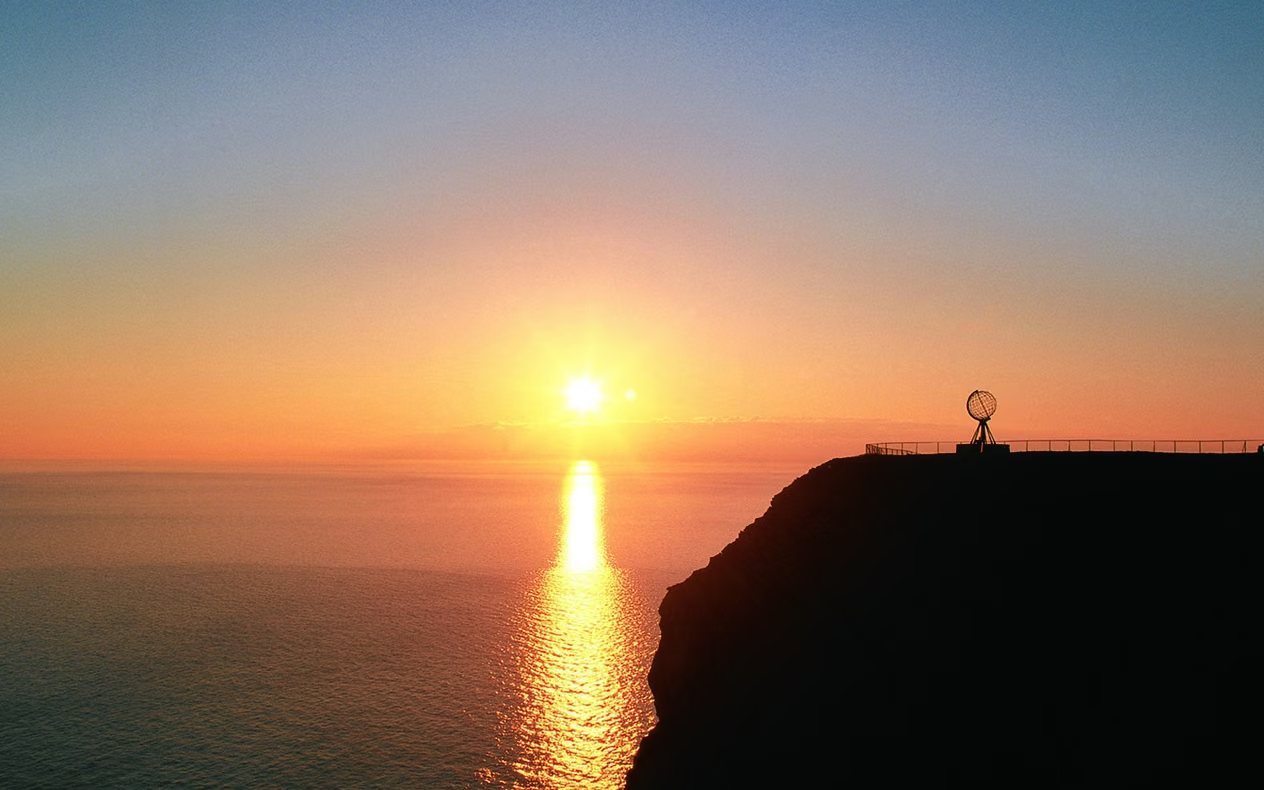
A 307 metre cliff at the top of mainland Norway
Bjørnøya, or Bear Island
74° 30′ N
Seabird cliffs in the middle of the Barents Sea
Longyearbyen
78° 13′ N
The main settlement in Svalbard
Ny-Ålesund
78° 56′ N
A research station, and the furthest north you go
The Story
A route with a past
Hurtigruten first sailed to Svalbard in 1896. Richard With had founded the coastal service three years earlier. His summer service between mainland Norway and Spitsbergen was known as the Sports Route.
A later version, the Svalbard Express, ran between Bergen and Svalbard from 1968 to 1982. Hurtigruten brought it back in June 2023 to mark the company's 130th anniversary. It is now called the Svalbard Line.
It is still a working route. On the way south the ship calls briefly at Tromsø to unload cargo brought down from Svalbard.
The Voyage
The route, port by port
The round voyage calls at 14 ports in 15 days, with a long stay in most of them. Several are small places that the big cruise ships do not visit. For anyone who likes the outdoors, the mainland ports are as much of a draw as Svalbard itself.
Northbound
Bergen. The starting point, with the old Hanseatic wharf of Bryggen on the harbour.
Åndalsnes. A small town beneath the Troll Wall, the tallest vertical rock face in Europe at roughly 1,000 metres. Walkers head for the Rampestreken viewpoint above the fjord.
Træna. An island community on the edge of the Arctic Circle, good for walking and cycling and thick with sea eagles.
Reine. A Lofoten fishing village since 1743, and one of the most photographed places in Norway.
Tromsø. A full day in the city that polar expeditions once sailed from.
Honningsvåg. The port for the North Cape.
The Barents Sea. A day at sea, passing Bjørnøya.
Longyearbyen and Ny-Ålesund. The two calls in Svalbard, covered below.
Southbound
Senja. One of the largest islands in Norway. You land at the fishing village of Torsken.
Stokmarknes and Svolvær. The Hurtigruten Museum, then the main town of Lofoten.
Bessaker. A village of a few hundred people on the Fosen peninsula.
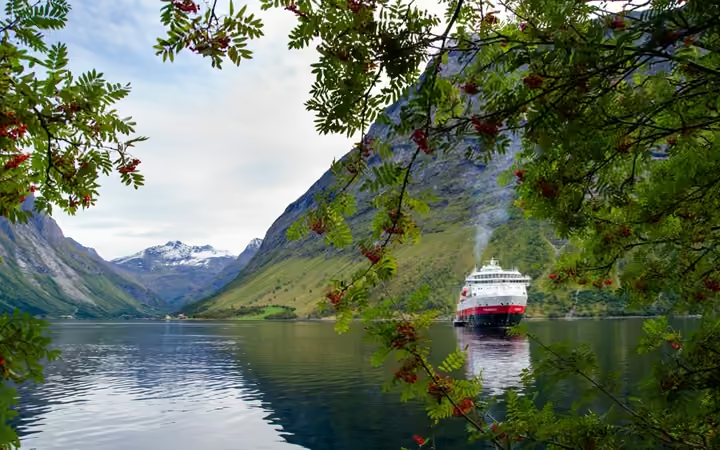
Ålesund. The Art Nouveau town, with 418 steps up Mount Aksla for the view and the Hjørundfjord close by.
The ship reaches Lofoten from the south. The mountains rise straight out of the sea, with no foothills to warn you.
Reine is built across small islands, with red fishermen's cabins on stilts over the water. The islands grew up on cod, which is still hung to dry on wooden racks in the open air.
For Photographers
The light: what the midnight sun really does
In Longyearbyen the sun does not set between 19 April and 23 August. Most Svalbard Line sailings fall inside that window, so for much of the voyage it never gets dark.
The sun also stays low. At midsummer in Longyearbyen it climbs to only about 35 degrees at noon, and it is still about 12 degrees above the horizon at midnight. In London the midsummer sun reaches about 62 degrees. So the low, warm light that photographers elsewhere get for an hour at each end of the day can last most of the night here.
The photograph at the top of this page shows the midnight sun on Liefdefjorden, in the north of Spitsbergen. The Svalbard Line does not sail that far north, but Isfjorden and Kongsfjorden get the same light.
There is a price to pay. With no darkness there are no stars and no Northern Lights. If the aurora is what you want, read our guide to the Northern Lights in Norway and look at a winter voyage instead.
From 23 August the sun begins to set again in Longyearbyen. The last sailings of the season get sunsets and twilight back.
Practical notes for cameras
Bring your longest lens and binoculars. The law keeps wildlife at a distance, as the next section explains.
Switch off Wi-Fi and Bluetooth at Ny-Ålesund. The rule covers cameras and watches as well as phones.
Leave the drone at home. Drones are banned in protected areas and at Ny-Ålesund. From 1 April to 31 August they are also banned within 500 metres of bird cliffs.
Pack a sleep mask. Your body clock will not believe it is night.
Ask the Expedition Team. They give photography guidance during the voyage.
For Wildlife Watchers
Wildlife: what you might see, and what you probably will not
You are likely to see reindeer and seabirds in large numbers. With luck you will see walrus or whales. A polar bear is possible but unlikely. Nobody can promise wildlife. These are the facts behind the main species.
Polar bears
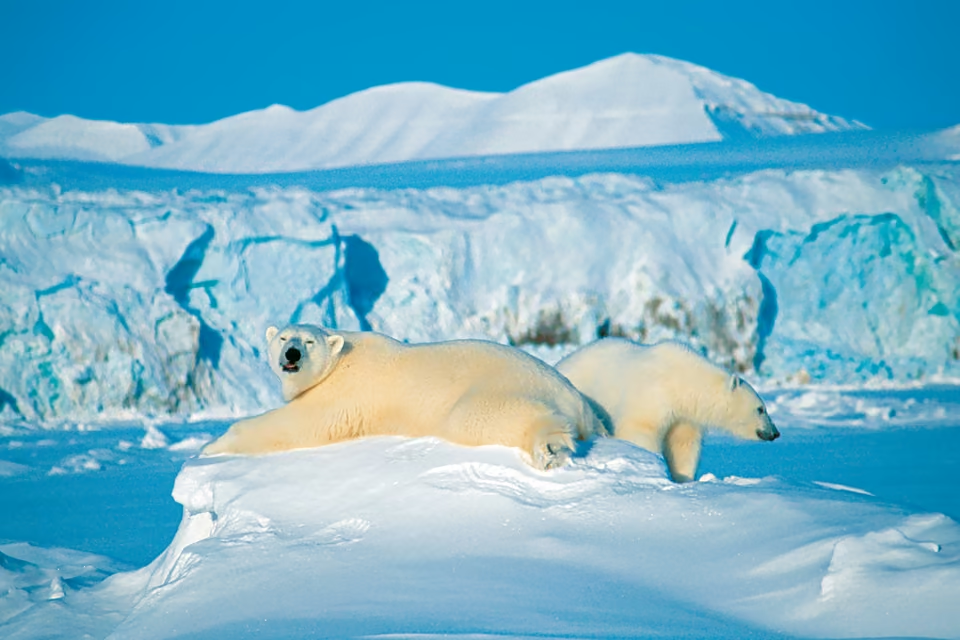
The old line that Svalbard has more polar bears than people is not true. In 2004 a Norwegian and Russian survey estimated about 2,650 bears across the whole Barents Sea region. Most of them live out on the pack ice. Roughly 250 to 300 stay around the Svalbard islands themselves.
From 1870 to 1973 hunters took about 300 bears a year. Norway has protected them completely since 1973.
Recent research has a surprise in it. A study published in 2026 looked at bears measured between 1995 and 2019. The sea ice shrank fast over that time, yet the bears' body condition improved from 2000 onwards. The researchers think the bears are eating more reindeer, walrus and other prey found on or near land. They also warn that it may not last.
Hurtigruten says plainly that polar bear sightings on this voyage are very rare. If a bear is seen, the law keeps everyone at least 300 metres away, and 500 metres from 1 March to 30 June. Those rules came into force on 1 January 2025.
Walrus
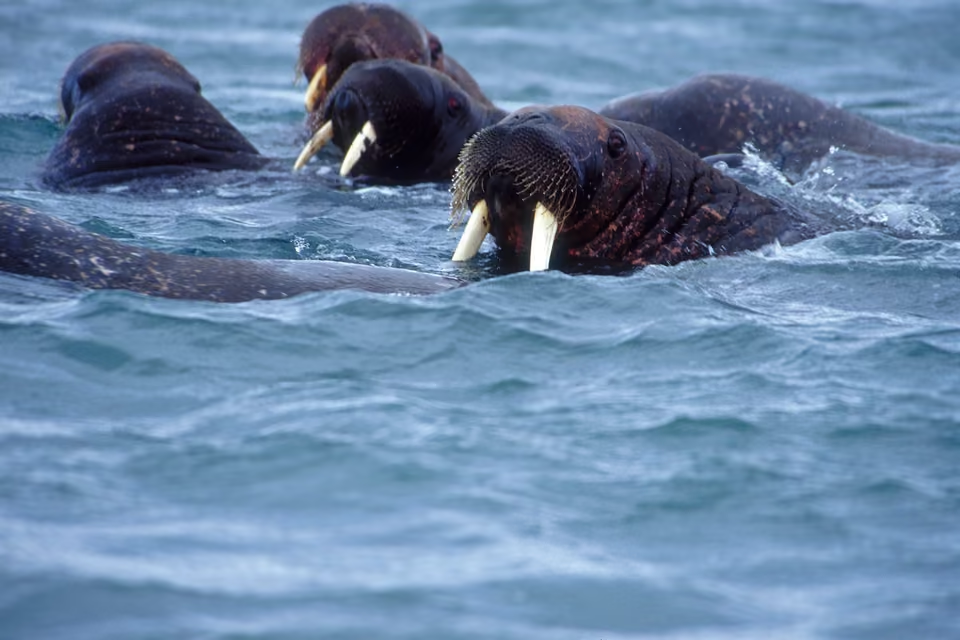
Walrus were hunted until only about 100 were left in Svalbard. They were protected in 1952. A survey in 2006 put the population at 2,629, and the 2018 survey put it at 5,503. Boats must stay at least 150 metres from the beaches where walrus haul out. They are sometimes seen in Kongsfjorden on the way to Ny-Ålesund.
Polar bears at the Von Post glacier. Sightings from the ship are rare. Photo: Venke IvarrudWalrus off Spitsbergen. Numbers have more than doubled since 2006. Photo: Petra Wöbke
Svalbard reindeer
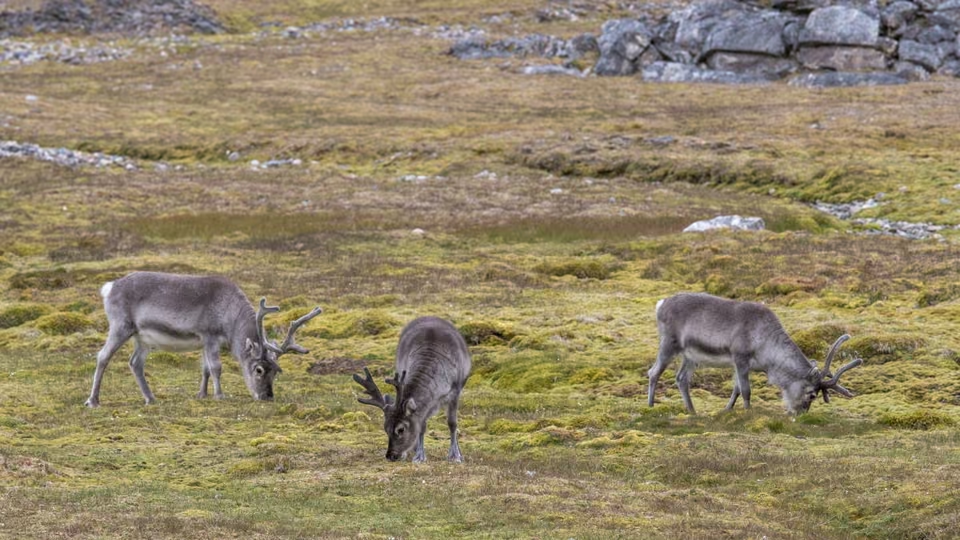
The Svalbard reindeer is found nowhere else, and it is the smallest reindeer in the world. It is stocky, docile and stays close to home. It was hunted almost to extinction and has been protected since 1925. A count published in 2019 put the population at about 22,000. You may well meet some grazing in Longyearbyen itself.
Seabirds
Bjørnøya lies about halfway across the Barents Sea. Around a million pairs of seabirds breed on its cliffs. It is one of very few places in the Atlantic where all six auks nest together in numbers: puffin, razorbill, little auk, black guillemot, common guillemot and Brünnich's guillemot. The island has been a nature reserve since 2002. The ship sails past and does not land.
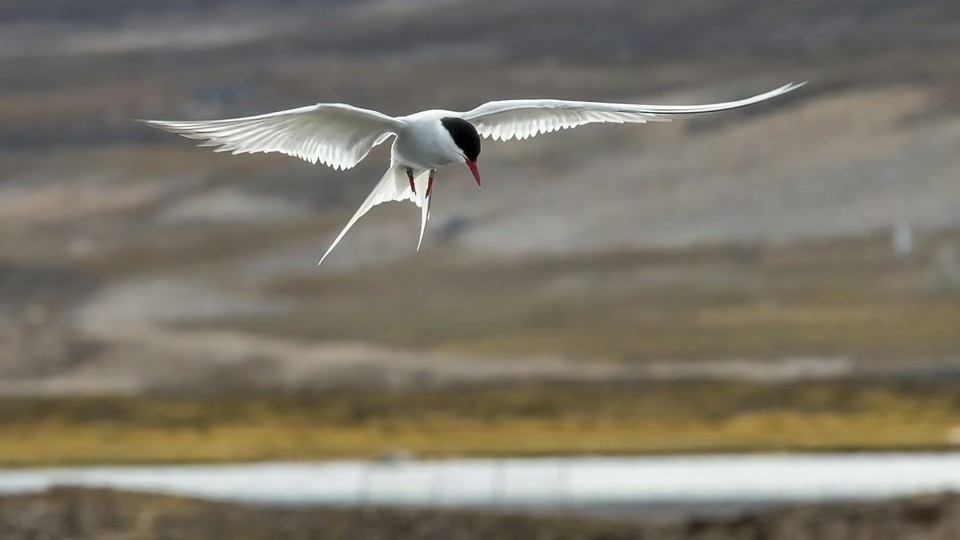
Around Longyearbyen and Ny-Ålesund, look for Arctic terns, barnacle geese, eiders and puffins. The Arctic tern is the great traveller. It nests here in summer, then flies to the Antarctic and back, the longest migration of any animal. It also defends its nest by diving at your head, so give nesting birds plenty of room.
Whales, foxes and the rest
Belugas are sometimes seen in the shallows of Kongsfjorden, and Arctic foxes live around Ny-Ålesund. On the sea days it is worth being on deck to watch for whales and dolphins. Hurtigruten's own advice is that early summer is best for migrant birds and late summer is better for whales.
Svalbard reindeer at Alkhornet, at the mouth of Isfjorden. Photo: Andrea KlaussnerAn Arctic tern at Ny-Ålesund, a long way from its winter home in the Antarctic. Photo: Andrea Klaussner
Going Ashore
Longyearbyen and Ny-Ålesund
The Svalbard Line makes two calls in Svalbard, both on the west coast of Spitsbergen. One is a small town. The other is a research station with strict rules for visitors.
Longyearbyen
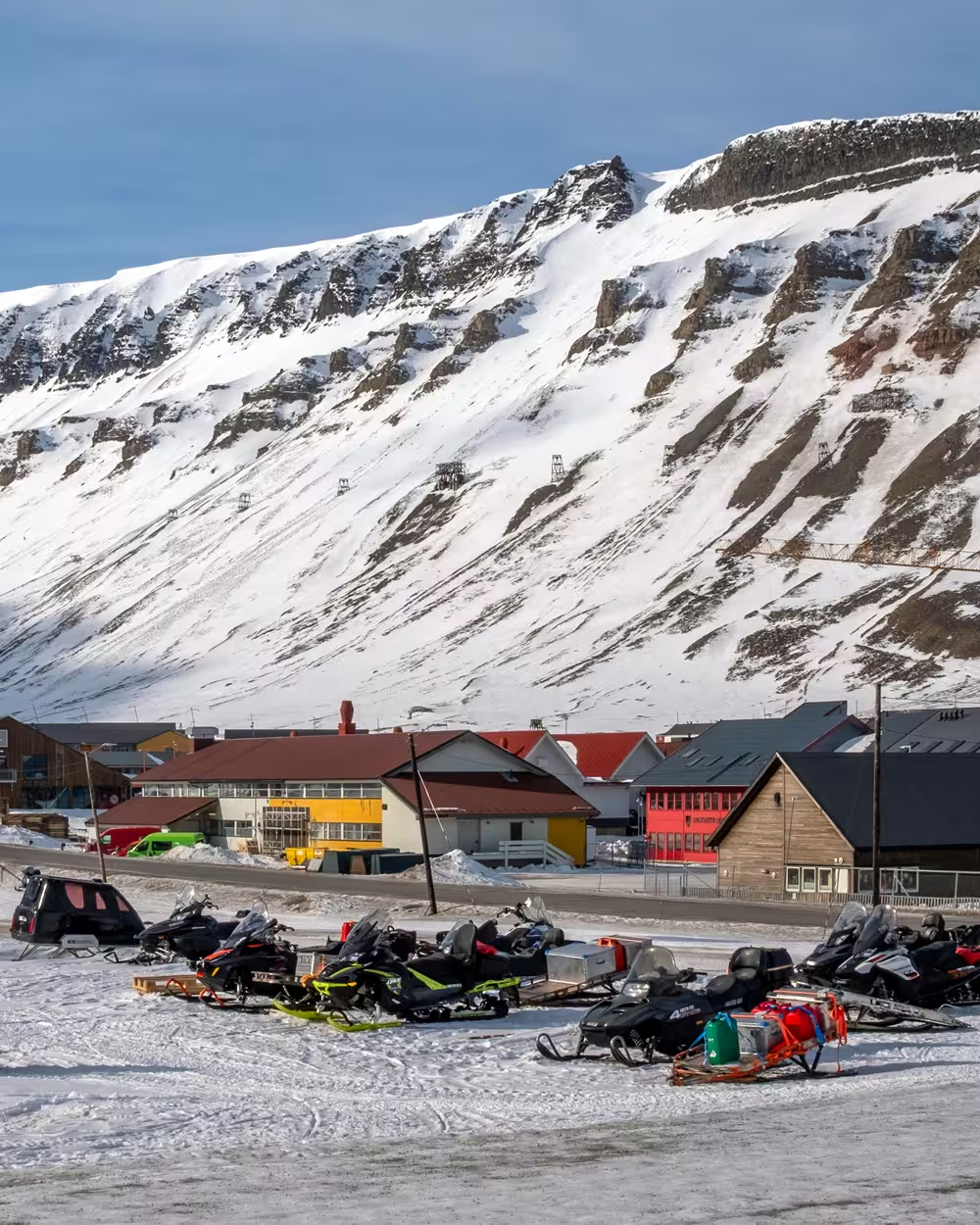
A coal town that turned to science
78 degrees 13 minutes north
Longyearbyen is named after John Munro Longyear, an American who came here on a cruise in 1901 and saw the coal. His company began mining in 1906. He sold it in 1916 to the Norwegian firm Store Norske.
Today the town is a base for scientists and visitors. It has a museum, galleries, restaurants and a brewery.
The Svalbard Global Seed Vault is dug into the mountain nearby. It opened in February 2008 as a backup for the world's crop seeds, and in June 2026 it passed 1.4 million samples. Visitors cannot go inside.
The wilderness starts where the houses stop. Because of polar bears, nobody leaves town without a guide who carries a rifle.
Ny-Ålesund
78 degrees 56 minutes north
Ny-Ålesund is one of the northernmost settlements in the world. It was founded as a coal mine in 1916. Mining ended in 1962 and science took over. About 40 people stay through the winter. In summer, researchers from more than 20 countries work here.
The whole settlement is radio silent. Within 20 kilometres you must switch off Wi-Fi and Bluetooth on every device, because the signals interfere with the instruments. You also keep to the roads, as the tundra itself is being studied.
There is a museum, a shop and the northernmost post office in the world. Outside the settlement stands the mast where Roald Amundsen moored the airship Norge before it flew over the North Pole in 1926.
Ny-Ålesund is on the round voyage and the southbound voyage. The northbound voyage ends at Longyearbyen and does not go there.
Timing
When to go
The Svalbard Line sails from May to September, and each part of the season is different.
When
What to expect
May and early June
Snow still on the mountains. Migrant birds arriving and the ice breaking up.
Late June and July
High summer. Around midsummer the sun is up all night from the Arctic Circle northwards, and the seabirds are nesting.
August
Better chances of whales. From 23 August the sun starts to set again in Longyearbyen.
September
The last sailings, with sunsets, twilight and the first autumn colour.
A general guide only. Weather and wildlife vary from year to year.
What is the weather like?
Average summer temperatures in Longyearbyen are about 4 to 6 degrees. A warm ocean current keeps Svalbard milder than its latitude suggests, but it is never warm. Bring a windproof jacket, a hat, gloves and walking boots, even in July. Our climate page covers the mainland coast.
The Voyages
Three ways to sail it
You can sail the full round voyage or either half. Each one way voyage takes eight days, and you fly to or from Longyearbyen at the other end.
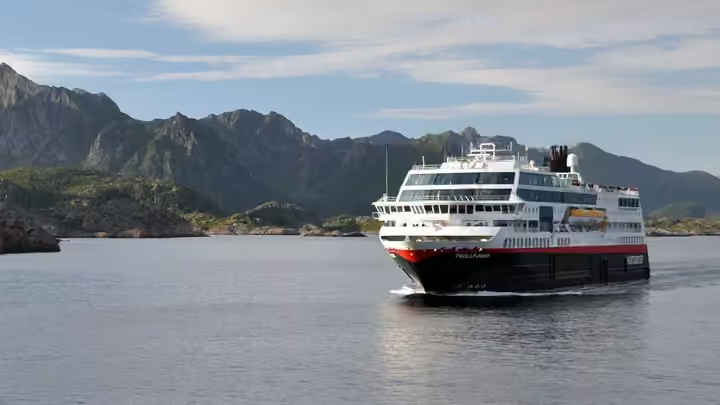
The ships are MS Trollfjord and, in 2027, MS Midnatsol as well. Both are Signature ships. All meals and selected drinks are included, and an Expedition Team sails with you to give talks and lead walks ashore.
Is this an expedition cruise?
No, and it is worth being clear about that. The Svalbard Line visits two places on the west coast of Spitsbergen. It does not sail around the archipelago. Expedition ships do that. They spend a week or more among the islands and land by small boat.
Choose the Svalbard Line if you want the whole Norwegian coast with Svalbard as the high point. Choose an expedition if Svalbard's wildlife is your only goal.
The Svalbard Line is a Hurtigruten voyage from Bergen along the Norwegian coast and across the Barents Sea to Svalbard. It sails from May to September. The round voyage takes 15 days and calls at 14 ports, including Longyearbyen and Ny-Ålesund.
How long does it take to sail from Bergen to Svalbard?
Eight days one way. The ship leaves Bergen, calls at ports along the coast, crosses the Barents Sea and reaches Longyearbyen on day eight. The full round voyage back to Bergen takes 15 days.
When does the Svalbard Line sail?
From May to September. This is the season of the midnight sun. In Longyearbyen the sun does not set between 19 April and 23 August.
Will I see polar bears on the Svalbard Line?
Probably not. Hurtigruten says sightings on this voyage are very rare. Roughly 250 to 300 bears live around the Svalbard islands. The law keeps ships and people at least 300 metres away, or 500 metres from 1 March to 30 June. Reindeer, seabirds and sometimes walrus are far more likely.
Can you see the Northern Lights on the Svalbard Line?
No. The voyage sails in summer, when it does not get dark this far north. For the Northern Lights you need an autumn or winter voyage.
Is the Svalbard Line an expedition cruise around Svalbard?
No. It visits Longyearbyen and Ny-Ålesund on the west coast of Spitsbergen and does not sail around the archipelago. Expedition ships do that. The Svalbard Line suits people who want the whole Norwegian coast with Svalbard as the high point.
How cold is Svalbard in summer?
Average summer temperatures in Longyearbyen are about 4 to 6 degrees. Bring a windproof jacket, hat, gloves and walking boots, even in July.
Do I need a visa or a passport for Svalbard?
Svalbard is part of Norway and needs no special visa. You do need a valid passport.
Can I use my phone and camera at Ny-Ålesund?
Yes, with Wi-Fi and Bluetooth switched off. Ny-Ålesund is a radio silent research station. The rule covers phones, cameras, watches and any other device within 20 kilometres of the settlement. Drones are not allowed.
Which ships sail the Svalbard Line?
MS Trollfjord, joined in 2027 by MS Midnatsol. Both are Hurtigruten Signature ships, with all meals and selected drinks included and an Expedition Team on board.
Plan Your Trip
Talk to us about the Svalbard Line
We are agents for Hurtigruten. Call us or send an enquiry and we will check dates and cabins for you. If you are not sure this is the right voyage, our voyage comparison sets it beside the others.
Sources: the Norwegian Polar Institute, the Governor of Svalbard, Visit Svalbard, Kings Bay, the Crop Trust, Statistics Norway, the Norwegian University of Science and Technology and Hurtigruten. Figures checked in November 2026. Photographs: Petra Wöbke, Andrea Klaussner, Venke Ivarrud and Hurtigruten.