

Hurtigruten - The History of Norwegian Coastal Voyages since 1893
It all started with the rich fishing grounds along the Norwegian coast. As this important seaway was lined with perilous reefs, small islands and narrow inlets it was essential that a safe trade route was established to link the southern and northern regions of Norway.
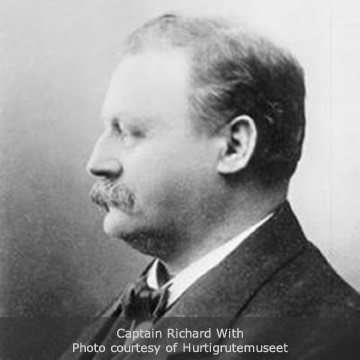
Maritime maps were unreliable at that time and there were only a few lighthouses north of Trondheim. When the Norwegian government decided to create a connection between north and south, Richard With and his friend Anders Holthe took on the challenge of thoroughly mapping the seas along the Norwegian coastline. In 1893, Captain Richard With's steamer, DS Vesteraalen, was bought into regular service along the coast of Norway, and Hurtigruten was established.
The service offered daily departures, first from Trondheim to Hammerfest and later from Bergen to Kirkenes in only 7 days. He called this important connection the 'hurtig ruten' (fast route). Today, Hurtigruten still takes freight and passengers. The captains use their extensive maritime expertise to ensure that guests and goods are safely carried from port to port. Today, as then, the Hurtigruten ships are a part of Norwegian coastal life. One of the fleet's 11 ships departs Bergen daily, sailing to Kirkenes and back in 12 days at an average speed of 15 knots.
Time line of Hurtigruten - the world's most beautiful voyage
1893
2 July the first Hurtigruten steamship DS Vesteraalen departs Trondheim for Hammerfest, visiting 11 harbours.
1898
The route expands southward to include Bergen with three weekly departures.
1908
Kirkenes, near the Russian border, becomes the northern turning point of the coastal voyage.
1925
The first ship to feature running water in all cabins is added to the Hurtigruten fleet.
1936
Daily departures from Bergen begin. More than 230,000 passengers a year sail between Bergen and Kirkenes on board Hurtigruten's fleet of 14 ships.
1937
Hurtigruten equips all ships with sonar, an electronic logbook and radio-tracking transmitter.
1939 - 1945
Half the Hurtigruten fleet is lost, and a total of 700 people lose their lives on board during World War II.
1945
The rebuilding of Hurtigruten is high priority, new ships are built and the route is back on track.
1952
Seven new ships are added in 3 years. The entire rebuilt Hurtigruten fleet now features modern diesel engines. Hurtigruten wins a unique position in Norwegian communications carrying 500,000 passengers annually.
1982
The first ships with a side hatch, for easy cargo handling, are added to the fleet. The new MS Vesterålen, MS Midnatsol and MS Narvik replace older vessels in the fleet.
1993
A new era begins with the launch of the modern MS Kong Harald. The modernisation of Hurtigruten's fleet will result in 9 out of the 11 ships being replaced by the end of 2003. This is the biggest 'makeover' in Hurtigruten's history
2001
On May 30, the Norwegian government lists MS Lofoten as a national historical monument.
2002
Two new ships, MS Trollfjord and MS Finnmarken, are launched.
2003
The new MS Midnatsol is launched in Hamburg, Germany - making it the first Hurtigruten ship ever to be inaugurated outside of Norway. A Hurtigruten ship, the MS Nordnorge, travels the southern waters around Argentina, Chile and the Antarctic for the first time in winter.
2005
Hurtigruten's traditional ships, the MS Nordstjernen and MS Lofoten, start sailing the so-called Nostalgic Routes in Norway in wintertime, alongside Hurtigruten's more modern ships.
2006
The MS Nordstjernen turns 50. The oldest OVDS and TSDS Hurtigruten shipping companies merge to form Hurtigruten ASA. From mid-March, the MS Finnmarken is the first Hurtigruten ship to travel with the new company trademark funnel paint: red with the white letter 'H'.
2007
In May, the new expedition ship MS Fram - at the time, the most modern vessel of its kind - starts service. Hurtigruten debuts a new route to Greenland.
2008
Hurtigruten celebrates its 115th birthday. For more than a century, its passenger and cargo ships have connected northern and southern Norway.
2010
MS Fram adds Spitsbergen to its unique Explorer portfolio, now sailing in polar waters in Greenland, Antarctica and Svalbard.